
Gutter Repair in Little Elm, TX
Gutter repair, replacement and new seamless runs, all quoted by Little Elm Roofing Co off a look at the actual edge.
A gutter that sheets straight over the front edge in a hard rain is telling you something, and it is rarely just leaves.
Roofing you can plan around
What gutter work covers.
Seamless aluminum is formed on site in one continuous run, so the only joints are at the corners and the outlets. What a house needs comes down to its stories, its corner count, how many downspouts carry the water away and what condition the fascia behind it is in.
Those are also what move the price: roughly $6 to $15 per linear foot installed against national ranges, or somewhere near $2,000 to $5,000 for a typical 150 to 200 foot home, with the real number coming off a written estimate.
Rain here does not arrive as all-day drizzle. North Texas is convective-storm country, so water comes in short, hard bursts, and short-burst intensity is exactly the number gutter sizing is built around. How hard rain falls on this town is the input, which is why the size question gets answered on the roof.
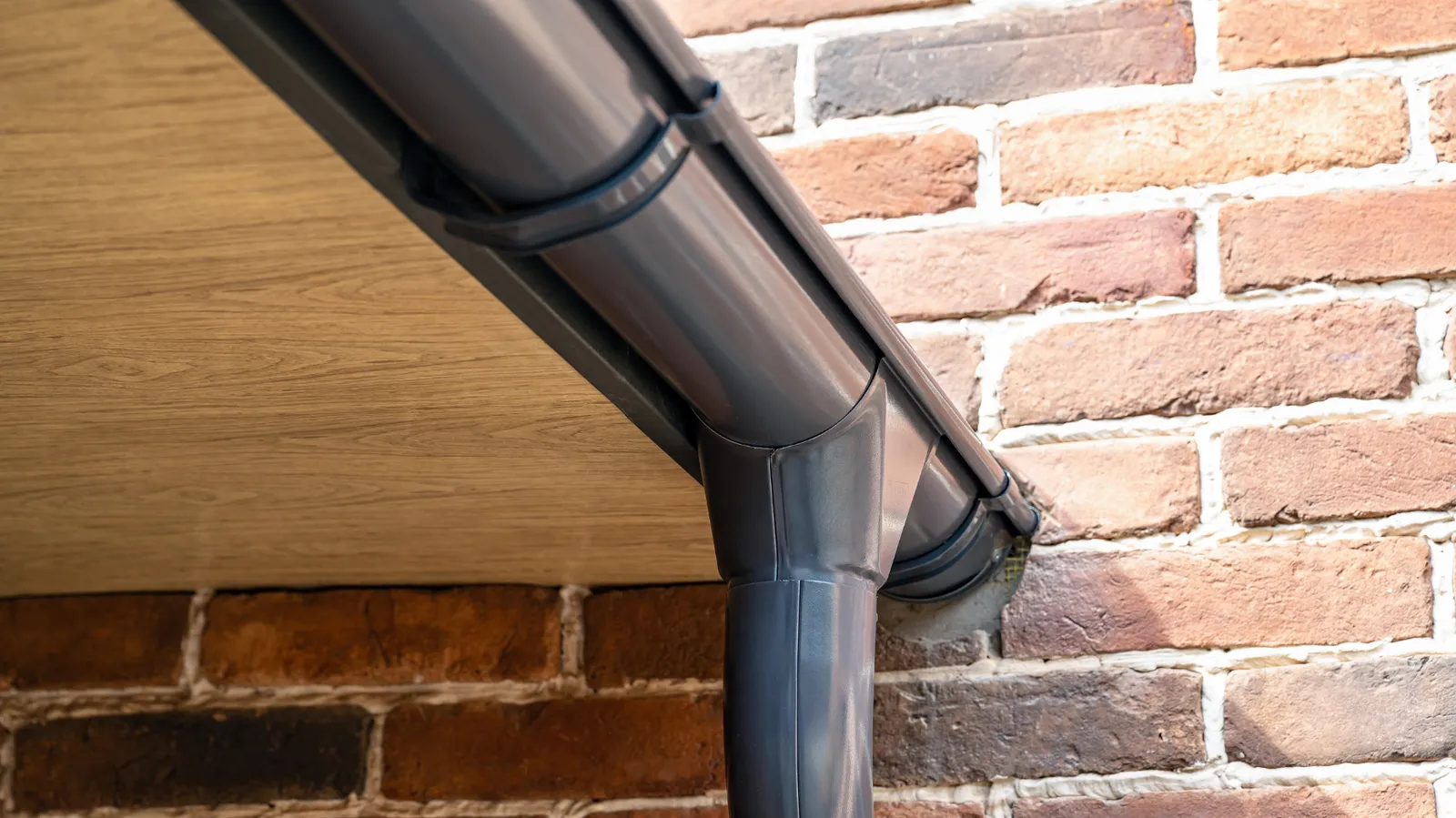
Sizing the run
Five-inch K-style is the default; six-inch suits bigger, steeper roofs.
Seamless, formed on site
The trough is roll-formed at your house into one continuous piece per run.
Downspouts and outlets
Downspouts sized and spaced to the trough, since too few outlets still overflow.
The fascia checked first
The fascia board is inspected before anything is fastened to it. Soft wood sags.
The drip edge handoff
Water comes off the edge, over the flashing and into the trough.
Discharge clear of the slab
Downspouts extended well clear of the foundation, which matters on this area’s clay soils.
Guards, where they earn it
Guards buy fewer ladder trips, never zero. Debris still piles on every type.
Signs the gutter line needs work.
Any one of these can be a small repair. Several together usually means the system itself.
Water over the front edge
Water spilling over the outside lip mid-rain means the trough, pitch or outlet is undersized.
Tiger striping down the face
Vertical gray streaks on the outside face are an overflow story, written by water going over the lip.
Sagging runs or backing fasteners
A gutter line dipping between hangers usually means the fascia behind it has gone soft.
Standing water in the trough
Water sitting in the gutter days after a storm points to lost pitch or a blockage.
Drips at seams and end caps
Sealant outlives nothing. Corners, joints and end caps are where a sectional system leaks.
Paint peeling at the roofline
Bubbling paint on the fascia below the gutter is a water story, not a paint one.
How a gutter call goes in Little Elm.
The first step takes longer than people expect. Most of it is working out where the water goes.
The whole run read
A roofer checks the pitch, the outlets, the fascia, and where water lands.
Repair or replace
One failed seam and a system that has lost its pitch are different problems.
The work and the figure
Footage, corners, downspouts, guards and fascia repair each on their own line.
Formed and hung
Seamless runs rolled at the house, hung on sound wood, discharge clear.
Gutter repair and installation questions.
Mostly about where the water goes once it leaves the shingles. And what it costs going the wrong way.
Get gutter repair in Little Elm, TX measured and quoted.
A roofer walks the whole run, checks the wood behind it, and prices what it needs line by line. The look is free either way, whether it's one bad seam or every foot of it.
Roofing you can plan around